UK charity, the Whitley Fund for Nature (WFN), recognised India’s Dr Barkha Subba with a 2026 Whitley Award to rapidly scale protection for the Himalayan salamander and its fragile wetland habitat in the Darjeeling Himalaya, West Bengal.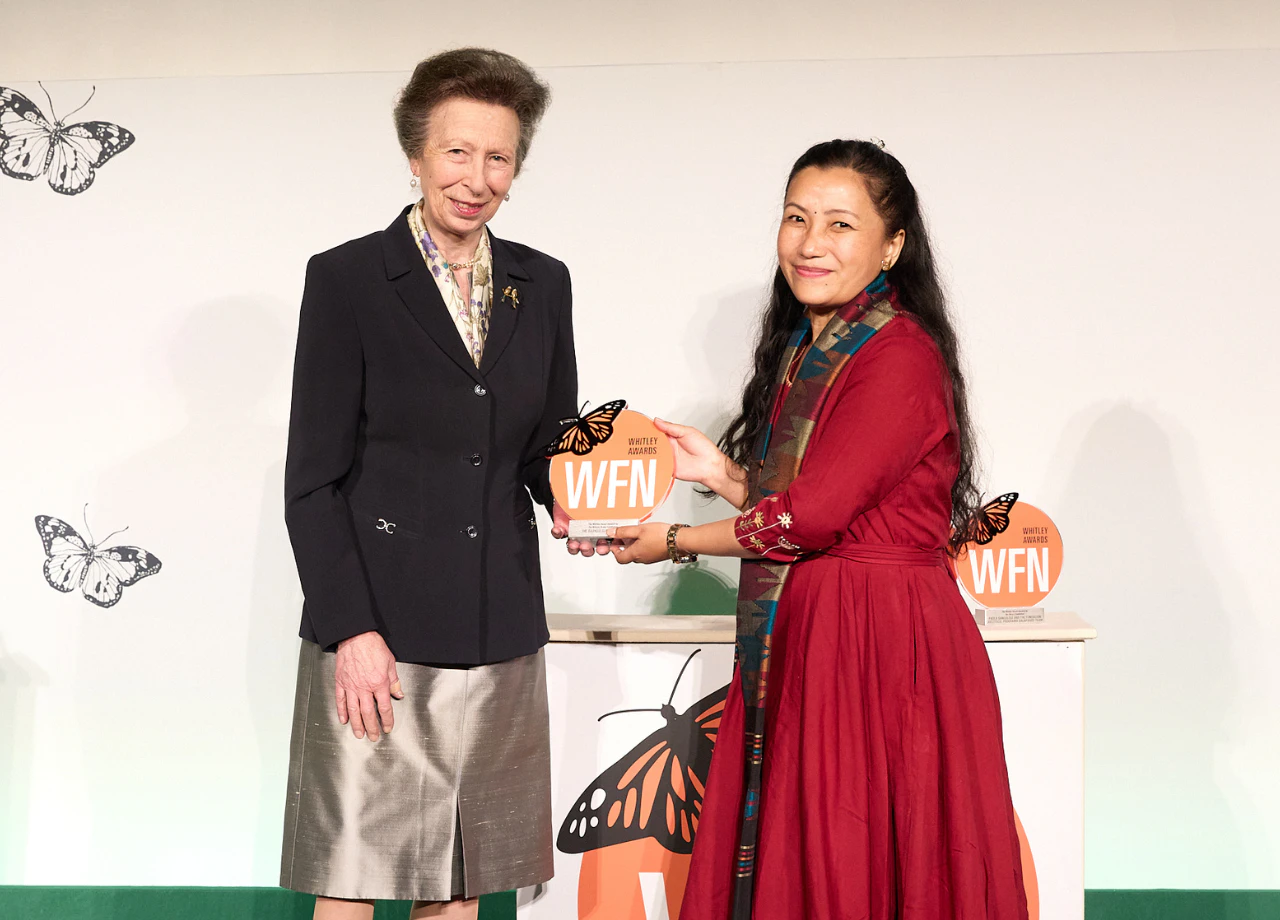
Meeting a salamander “feels like meeting a messenger from deep evolutionary time – a reminder of how long nature has endured and how quickly we can lose it.”
With her Whitley Award, Barkha will focus on seven of the most critical breeding sites of the rare and evolutionarily distinct amphibian, which like all salamanders can regenerate full limbs. Wetland loss, unregulated tourism and tea garden land diversification are altering habitat and shrinking breeding areas. Approximately 30 breeding sites remain locally – many of which lie outside protected areas.

Charity Patron, HRH The Princess Royal presented the Whitley Award on 29 April at the Royal Geographical Society. The event was livestreamed to YouTube. WFN Ambassador Sir David Attenborough said conservation work has never been more urgent: “We need the work of Whitley Award winners to succeed and to help them to whatever extent possible.”
The scientific adviser at local NGO, Federation of Societies for Environmental Protection (FOSEP), Barkha will lead the first coordinated grassroots effort to secure the future of the Himalayan salamander in Darjeeling. Her project will restore habitat, remove invasive species, screen for the deadly chytrid fungal disease, as well as engage local people in awareness programmes promoting sustainable land use and eco-friendly tourism.
Endemic to India, Nepal and Bhutan, the Himalayan salamander, which can grow up to 17 cm in length and live for up to 11 years, was once widely distributed across Darjeeling’s cool, shaded wetlands and forest fringes. Salamanders return to their natal site to breed and lay eggs – a process known as philopatry – which makes them highly vulnerable to change in habitat and an indicator of wetland health.
The habitat of the Himalayan salamander in the Darjeeling tea landscape, is undergoing complex changes. Cheaper Nepal tea, often marketed as ‘Himalayan tea’, has increased competition for estates at a time when climate change, erratic rainfall and ageing plantations have pushed down yields. Legacy estates are being acquired by companies focused on profits and also diversifying into tea tourism to remain economically viable. At the same time, the region faces growing environmental challenges, including landslides, soil erosion, and shrinking freshwater sources linked to development.
The species is now listed as Vulnerable on the Red List of the International Union for Conservation of Nature (IUCN) as wetlands are increasingly drained, filled, polluted or disturbed. Barkha’s ultimate goal is to create a transboundary framework for wetland protection that extends to Nepal and Bhutan.

“What keeps me going is what I see on the ground. I see communities standing up for places they love. I see young people choosing to protect rather than exploit. I see forest officials ready to listen and cooperate. I see a species that has survived for millions of years, still trying, still returning home.”
Globally wetlands are disappearing faster than any other ecosystem and one fifth could be lost by 2050. They regulate floods and store carbon. When managed effectively, the world’s 1.4 billion hectares of wetlands deliver ecosystem services worth up to $39 trillion (£29 trillion) annually — more than any other type of ecosystem, according to the Convention on Wetlands, the intergovernmental treaty which promotes the protection and sustainable use of wetlands globally.
With her Whitley Award project, Barkha will strengthen partnerships with local communities, tea estate managers, and government agencies to cover the salamander’s breeding sites in: Margaret’s Hope and Nakhapani which are both within tea gardens; Namthing Biodiversity Heritage Site which is on government land; Majhidura which is both forest department and community land; Mirik, which is privately owned; and two sites at Pokhriabong which are shared between the forest department and local communities.
The wetlands where Himalayan salamanders breed are culturally revered water bodies, associated with local deities and rituals. In many villages, disturbing them has historically been discouraged. This respect extends to all life supported by these wetlands, including the Himalayan salamander, according to Barkha, who comes from an Indigenous community in Darjeeling and describes the salamander as resembling “a tiny dragon that swims quietly in a mountain pond.” Many local people began protecting it long before there was funding, recognition, or even encouragement.
Famous for what’s known as “the champagne of teas,” Darjeeling has experienced a boom in tourism to its landscape of misty forests and high altitude tea estates created in the 19th century by the British Raj to reduce its dependence on Chinese tea. Tea gardens make up about one-fifth of land area in the Darjeeling hills. The region includes the Darjeeling Himalayan Railway, a UNESCO world heritage site, and spectacular views of Mount Kanchenjunga, the world’s third highest mountain.
HIGH-RES IMAGES AVAILABLE HERE
NOTES TO EDITORS – WHITLEY FUND FOR NATURE
The Whitley Fund for Nature (WFN) is a UK charity supporting grassroots conservation leaders in the Global South. Since its creation in 1993, it has channelled £26 million to over 230 conservationists working across 84 countries.
An early pioneer in the sector WFN was one of the first charities to channel funding directly to projects led by in-country nationals. Its rigorous application process identifies inspiring individuals who combine the latest science with community-based action.
WFN’s flagship prizes – Whitley Awards – are presented by charity Patron, HRH The Princess Royal, at a prestigious annual ceremony in London at the Royal Geographical Society (RGS). Winners receive funding, training, and profile boost, including short films.
The 2026 Whitley Awards Ceremony took place on Wednesday 29 April at the RGS and streamed live to YouTube. The other 2026 Whitley Award winners are:
- Dr Marina Kameni from Cameroon who is reviving endemic amphibian populations in Southwest Cameroon, a global hotspot for threatened amphibians, including the world’s largest frog.
- Dr Moreangels Mbizah from Zimbabwe who is expanding a coexistence model of conservation in northern Zimbabwe that allows the movement of lions between protected areas and community land.
- Dr Paola Sangolquí from Ecuador who is protecting the nesting sites of the Critically Endangered Galápagos Petrel from invasive species.
- Dr Issah Seidu from Ghana who is saving guitarfish along Ghana’s western coastline and advancing plans to create the country’s first Locally Managed Marine Area.
- Parveen Shaikh from India who is expanding protection for the Indian Skimmer and her model of community-led riverine bird conservation to Prayagraj in the Ganga Basin.
Every year, a past Whitley Award winner is chosen to receive the Whitley Gold Award, which has increased to £120,000, in recognition of their outstanding contribution to conservation. The Whitley Gold Award recipient also acts as a mentor to Whitley Award winners and an international ambassador for conservation success.
The 2026 Whitley Gold Award winner is Indonesia’s Farwiza Farhan who is accelerating community protection of water catchments in the Leuser Ecosystem in Sumatra, where devastating storms and floods last year compounded more than three decades of deforestation.
FOR INTERVIEW REQUESTS AND INFORMATION, CONTACT:
Carol Roussel, Head of Media, Whitley Fund for Nature
T: 07379 019 804
Josephine Higgins, Head of Communications, Whitley Fund for Nature


