UK charity, the Whitley Fund for Nature (WFN), recognised Dr Moreangels Mbizah with a 2026 Whitley Award to expand a coexistence model of conservation in northern Zimbabwe that allows the movement of lions between protected areas and community land and which has reduced human-wildlife conflict incidents in local wards by as much as 98 percent.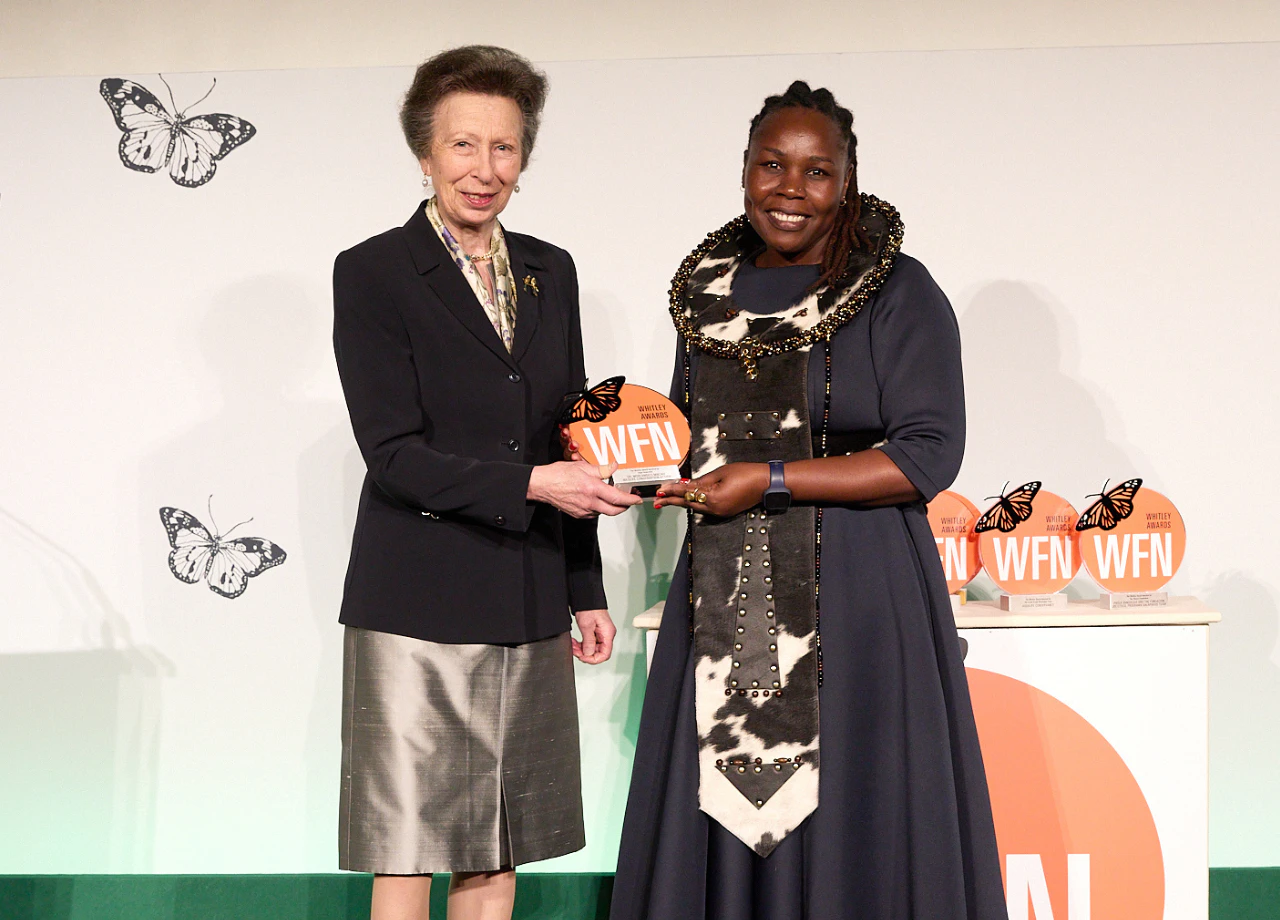
“With documented reductions in human-wildlife conflict of up to 98 percent in some wards, the model demonstrates that coexistence is not just an ideal, but an achievable outcome when trust, science and community leadership are aligned.”
A zoologist and founder of the NGO Wildlife Conservation Action (WCA), Moreangels has led interventions that span 2.6 million hectares in the low-lying Zambezi Valley, protecting almost 18,000 livestock, such as cattle and goats, worth $2.3 million. This is building capacity within local communities to sustainably manage their wildlife.
Charity Patron, HRH The Princess Royal presented the Whitley Award on 29 April at the Royal Geographical Society. The event was livestreamed to YouTube. WFN Ambassador Sir David Attenborough said conservation work has never been more urgent: “We need the work of Whitley Award winners to succeed and to help them to whatever extent possible.”
Lions have lost as much as 90 percent of their former range with fewer than 19,000-20,000 individuals remaining in the wild in Africa. Major threats include habitat loss and fragmentation as well as increased human settlement. This is bringing lions into contact with people and their livestock, which can prompt retaliatory killings when lions attack. Local people measure wealth in livestock, with each cow worth as much as US$300 and a goat worth US$30. The average income per household is US$108 per month.
Moreangels’ Whitley Award project will add three new wards of communal land in Mbire District to the 15 that her team currently works with and recruit six Community Guardians to report and respond to human-wildlife conflict incidents. They will assist with monitoring of the movement of lions and deploy conflict mitigation measures, which include mobile predator-proof enclosures, strengthening existing enclosures and use of lion lights, which are solar powered deterrents to the apex predator. The remote region where WCA works along the border with Mozambique and Mana Pools National Park is a UNESCO World Heritage site with the only flood plain ecosystem left in the Middle Zambezi. It has become a frontline human-wildlife conflict hotspot, particularly for elephants and lions. The landscape, characterised by the vast semi-arid savanna, mopane tree woodlands, acacia trees and the Zambezi River, experiences high temperatures and recurring droughts.
The proactive deployment by WCA of hundreds of predator-proof enclosures known as mobile bomas, the reinforcement of thousands of kraals, dwellings for livestock that are predator proof, and hundreds of lion lights has represented a major safeguard for community livelihoods, ensuring that families retain the wealth, food security and stability their livestock provides. Families would typically own about five cows and nine goats to support their families.
The team has successfully reduced the number of conflict incidences by 49 percent across three districts since 2021, with incidences almost entirely eliminated in two of the wards where they work.
Moreangels, whose doctoral work included tracking “Cecil the Lion” – killed by a trophy hunter in Zimbabwe in 2015, is targeting a long term increase in the lion population in the Mid Zambezi Valley landscape by about 10 percent to 660 individuals.
Mbire is part of a globally significant transboundary conservation landscape linking Zimbabwe, Zambia and Mozambique. Zimbabwe’s Mid-Zambezi Valley is known for its emblematic mega-fauna. Over the past 30 years rapid land use change in this area has substantially reduced wildlife habitat. While lions hold deep and complex significance for local communities in Mbire District, embodying both cultural reverence and real world risk, they are also feared because they pose genuine threats to livelihoods and safety.
HIGH-RES IMAGES AVAILABLE HERE
NOTES TO EDITORS – WHITLEY FUND FOR NATURE
The Whitley Fund for Nature (WFN) is a UK charity supporting grassroots conservation leaders in the Global South. Since its creation in 1993, it has channelled £26 million to over 230 conservationists working across 84 countries.
An early pioneer in the sector WFN was one of the first charities to channel funding directly to projects led by in-country nationals. Its rigorous application process identifies inspiring individuals who combine the latest science with community-based action.
WFN’s flagship prizes – Whitley Awards – are presented by charity Patron, HRH The Princess Royal, at a prestigious annual ceremony in London at the Royal Geographical Society (RGS). Winners receive funding, training, and profile boost, including short films.
The 2026 Whitley Awards Ceremony took place on Wednesday 29 April at the RGS and streamed live to YouTube. The other 2026 Whitley Award winners are:
- Dr Marina Kameni from Cameroon who is reviving endemic amphibian populations in Southwest Cameroon, a global hotspot for threatened amphibians, including the world’s largest frog.
- Dr Paola Sangolquí from Ecuador who is protecting the nesting sites of the Critically Endangered Galápagos Petrel from invasive species.
- Dr Issah Seidu from Ghana who is saving guitarfish along Ghana’s western coastline and advancing plans to create the country’s first Locally Managed Marine Area.
- Parveen Shaikh from India who is expanding protection for the Indian Skimmer and her model of community-led riverine bird conservation to Prayagraj in the Ganga Basin.
- Dr Barkha Subba from India who is leading the first grassroots movement to protect the Himalayan salamander and its fragile wetland habitat in the Darjeeling Himalaya, West Bengal.
Every year, a past Whitley Award winner is chosen to receive the Whitley Gold Award, which has increased to £120,000, in recognition of their outstanding contribution to conservation. The Whitley Gold Award recipient also acts as a mentor to Whitley Award winners and an international ambassador for conservation success.
The 2026 Whitley Gold Award winner is Indonesia’s Farwiza Farhan who is accelerating community protection of water catchments in the Leuser Ecosystem in Sumatra, where devastating storms and floods last year compounded more than three decades of deforestation.
FOR INTERVIEW REQUESTS AND INFORMATION, CONTACT:
Carol Roussel, Head of Media, Whitley Fund for Nature
T: 07379 019 804
Josephine Higgins, Head of Communications, Whitley Fund for Nature


