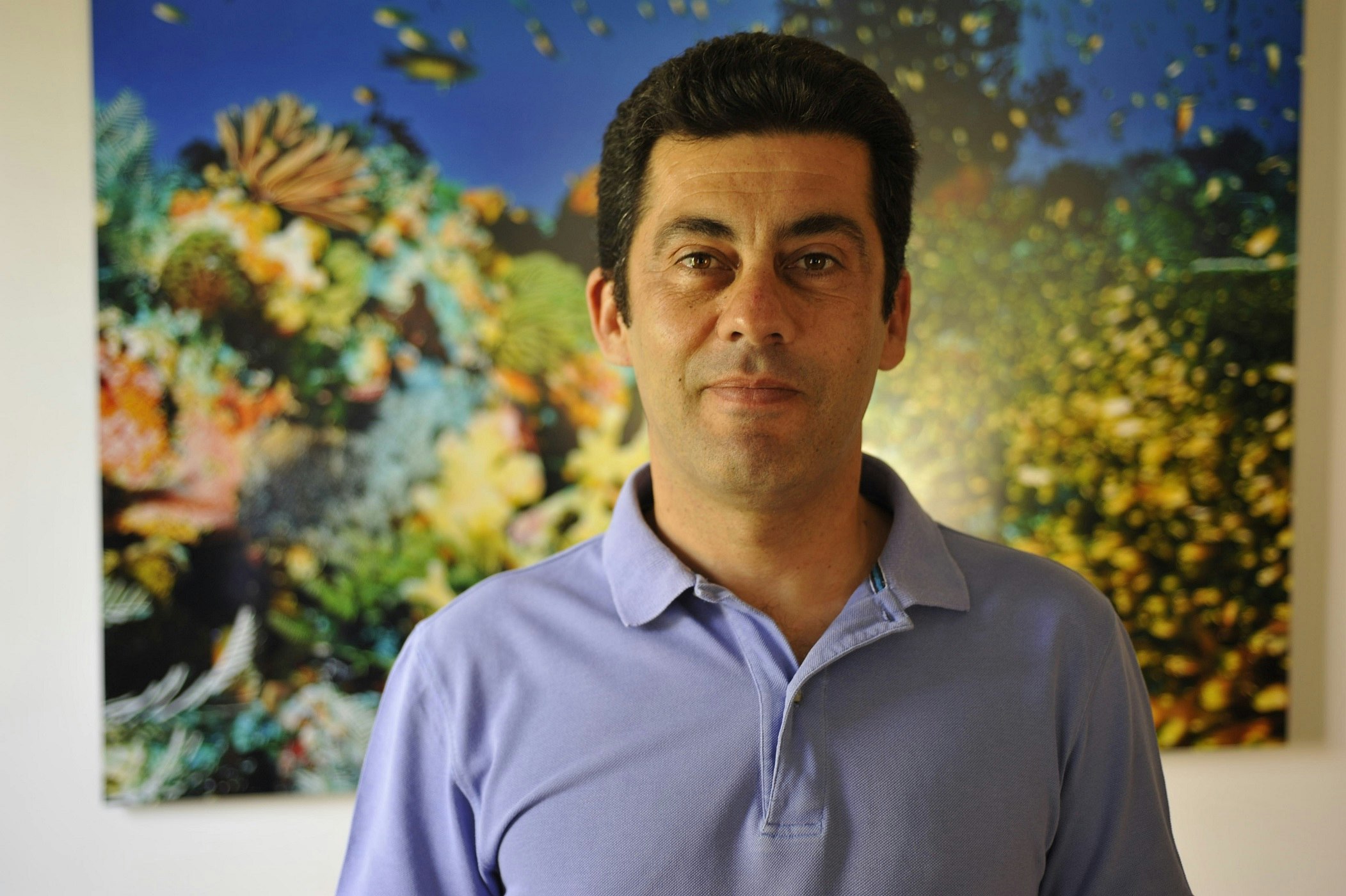
Winner of the Whitley Gold Award donated by The Friends and Scottish Friends of the Whitley Fund for Nature
Each year a member of our winner network is selected to receive the Whitley Gold Award, a profile prize worth £50,000 in project funding, awarded in recognition of their outstanding contribution to conservation.
Gökova Bay harbours important species including the Critically Endangered Mediterranean monk seal and Vulnerable sandbar shark. There are over 200 small-scale fishermen and women depending on fisheries in the Bay. Severe depletion of marine stocks in recent years has had a serious economic impact on local livelihoods.
Following a successful community conservation project led by Zafer and his team at the Mediterranean Conservation Society, the Turkish government declared six No Fishing Zones (NFZs) in 2010 to protect breeding and nursery grounds. These no-take zones represented the country’s first network of community-managed marine reserves. Due to the size of the area however, effective enforcement by the coastguard was difficult, so a locally-based marine ranger system was introduced to patrol the reserves against illegal activities.
Climate change has already taken its toll, with water temperatures rising in the eastern Mediterranean over the past decade. This has led to an increasing migration of invasive marine species to the area, with profound effects on the local ecosystem and fisheries sector. To address this, a campaign to promote the consumption of marine stowaways and transform their sale into a commercially viable sector of the local fisheries industry is underway.
Against a backdrop of challenging political circumstances and mass immigration of refugees from Syria and Iraq, Zafer is ensuring conservation efforts continue alongside humanitarian work, and is having a positive impact on both fishers and marine life in Turkey.
A Whitley Award winner in 2013 and a recipient of Continuation Funding in 2015, with the support of WFN and other donors, Zafer’s project has:
- Increased the size of NFZs by 25%, protecting a total of 3,000km2 of marine habitat in Gökova Bay.
- The coastguard and Ministry are now cooperating and effectively patrolling the reserves in partnership with local rangers. Patrol boats are equipped with specialist police cameras and GPS, allowing Illegal activity to be live streamed to authorities so they can respond immediately.
- Fish stocks have recovered and biomass has risen by 800% as a result of the reserves and spill-over into fishing grounds.
- New technology is at the heart of Gökova’s transformation. Zafer’s team have employed a new SMART monitoring system to aid research and law enforcement. It is the first of its kind to be used in the marine environment.
- Zafer has assisted communities to implement more sustainable fishing practices that reduce by-catch, and trawling has been banned in sensitive sites across an area covering 2,676km² – the largest in Europe for biodiversity and fish stock conservation.
- The community now keep detailed reports on the number and species of fish caught. It is the only Bay to do so in Turkey. They even have a mobile app for recording data!
- Following a campaign promoting the consumption of invasive species, fisher income has risen by 400% and native grouper species are on the rise.
- Critically Endangered monk seals have recently returned to the Bay and sandbar sharks and loggerhead turtles are being recorded in increased numbers; a sign that this once damaged ecosystem is on the road to recovery.
With his Whitley Gold Award, Zafer and his team will:
- Develop financing mechanisms for the Gökova Bay marine protected area capable of supporting at least 25% of ongoing activities to cement project sustainability.
- Scale up threatened species and habitat monitoring in the Gökova and Fethiye
Bay areas and use data to secure connectivity and protection of viable breeding populations across a 10,000 hectare sea-scape. - Explore project expansion to new sites internationally throughout the Mediterranean, working with government and international partners.
“Once communities started seeing the positive results of marine protection we gained their support.”
2025 CONTINUATION FUNDING
Strengthening protection of Türkiye’s Gokova Bay, one of the world’s most successful Marine Protected Areas
Zafer’s pioneering work to protect Türkiye’s Gokova Bay, one of the most ecologically important marine areas in the Mediterranean, has been recognised as among the most successful Marine Protected Area models globally. One of the most overfished and degraded seas on earth, temperatures in the Mediterranean are rising 20 percent faster than elsewhere. Warmer waters have attracted invasive species which could exceed 30 percent of total biomass by 2030.
The Mediterranean Conservation Society (MCS), of which Zafer is president and founder, created Türkiye’s first community-led marine conservation model in Gokova Bay. That included coastal fishing cooperatives, establishing No Fishing Zones and initiating the country’s first co-managed Fishery Restricted Area. The team introduced a marine ranger system to patrol the reserves against illegal activities. MCS has since scaled to cover seascape restoration across 310 miles of coastline and extended protection to over 160 square miles of new marine areas. Since the team organised the first-ever filming of bottom trawling for the film Ocean with David Attenborough, an EU Court has ruled that Marine Protected Areas must be protected from bottom trawling.
With Continuation Funding, Zafer aims to deepen and expand protection in Gokova Bay and designate 1,000 ha of No-Fishing zones and 20,000 ha of Fisheries Restricted Areas. This will be supported by improved enforcement and real-time surveillance using Earth Ranger and Skylight technology. The team will restore seagrass beds, reefs and degraded benthic habitats, giving special attention to areas impacted by bottom trawling. Invasive marine species, which include lionfish and rabbit fish, will be promoted as marketable seafood, supporting local fisheries and building on partnerships with more than 30 restaurants which now promote invasive species as sustainable food.
Find out about Zafer’s 2013 Whitley Award project here.


