Scientists estimate that 50 percent of all species are on the move.
Warming temperatures are driving species towards the poles and species are moving towards higher elevations. Habitat change and loss are also forcing species to adjust to an increasingly fragmented, human landscape.
Around the world, Whitley Award-winning conservationists are implementing local solutions to the biodiversity and climate crises. With adaptation and resilience in the spotlight at COP30 in Brazil, we asked our global network of winners for their observations on the species they work with every day.
From resilience in some coral species in the face of warming oceans to expanding grassland and shifting breeding patterns, learn how species are adapting to a changing planet in surprising ways.
SPECIES on the move
A flagship panel with five Whitley Award winners at our People for Planet Summit, explored further examples at the Royal Institution’s historic auditorium where Thomas Henry Huxley defended Charles Darwin’s The Origin of Species.

Dr Rachel Graham shared the “unsolved case” of once predictable aggregations of whale sharks in Belize, now no longer occurring. With this shift in movement being mirrored in Honduras, despite a different food source for whale sharks in the area, and in Panama – where orcas appeared instead. In Sri Lanka, Anjali Watson and team have observed that leopards have become almost entirely nocturnal – not in response to climate but to avoid humans.
Farwiza Farhan, whose focal species is humans as part of her work to protect Indonesia’s Leuser ecosystem, made the important link between changing climates, livelihoods, and human migration. “When you can’t continue living the way you have done for generations, the next thing you do is you move. Because like any other species, we are adaptable that way.” Her example of climate change impacting crop choices and farming practices, specifically Arabica coffee that is being farmed further up mountains due to failing crops, was echoed by Anjali’s example of changes in mist impacting tea production in the Sri Lankan highlands.
THE OCEANS
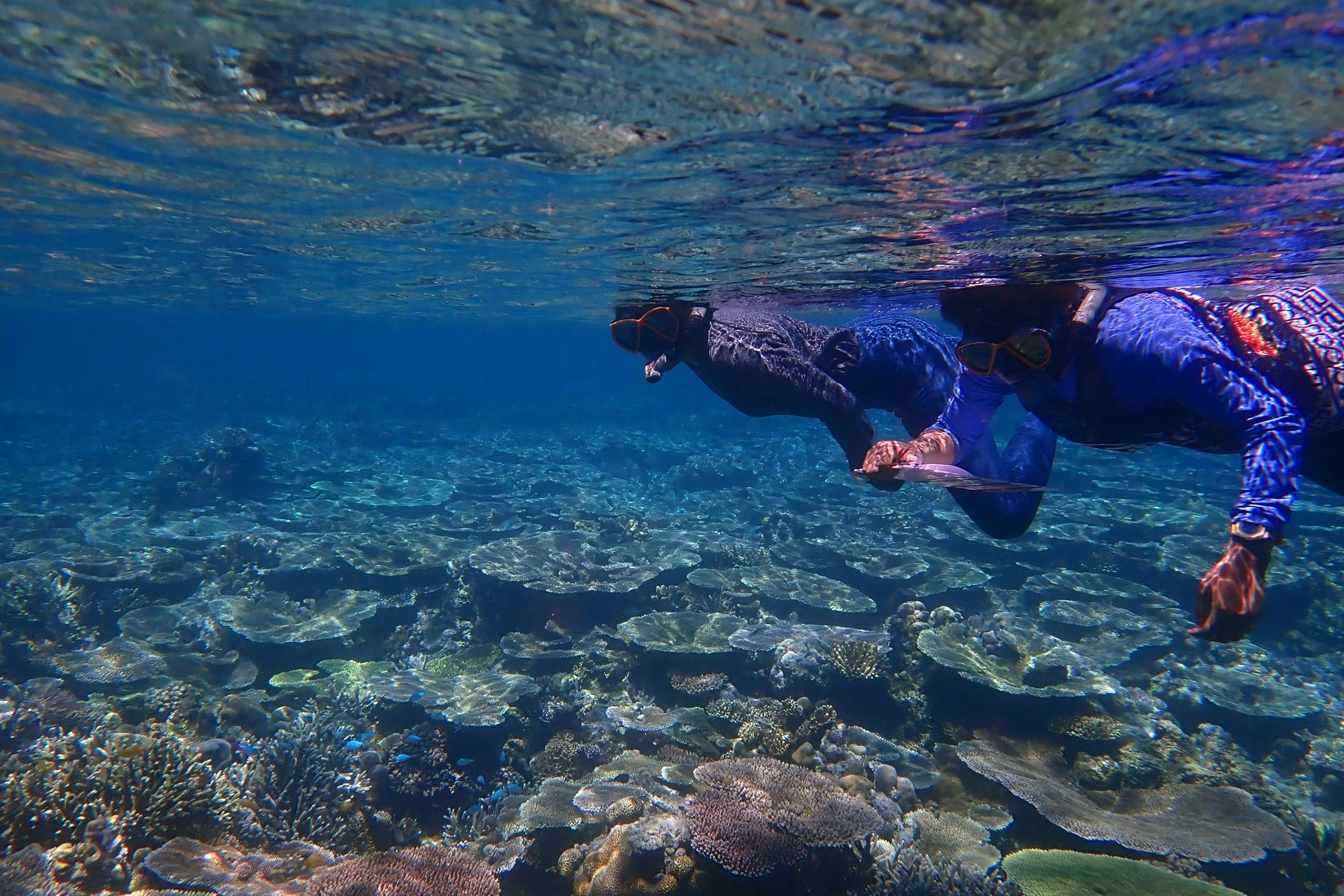
Papua New Guinea sits within the Coral Triangle, where coral species are more abundant than anywhere else on the globe, and the marine ecosystem sustains an estimated 120 million people. Naomi Longa, Co-Director, Sea Women of Melanesia, has observed resilience in some coral species in the face of warming oceans. “Coral mortality because of bleaching, which had been expected to reach 100 percent, was under 20 percent, suggesting some species in the genus Acropora are becoming more resilient to heat stress,” she says.

On the other side of the world, in Haiti, species are adapting their physical range in response to changing conditions: “The coral species Acropora cervicornis has started seeking deeper water to escape the effects of rising ocean temperatures,” explains Jean Wiener, Founder, Fondation pour la Protection de la Biodiversité Marine (FoProBiM).

Along Colombia’s wild Pacific coast, where endangered sea turtles are under pressure from both climate change and human activity, Dr. Diego Amorocho, Founder, Centro De Investigacion Para El Manejo Ambiental Y El Desarrollo (CIMAD), has been studying turtles for over three decades. He notes, “Hawksbill turtles are growing 1cm in length and 500g in weight annually, possibly benefiting from increased reliance on mangrove feeding areas amid coral bleaching.” His observation demonstrates not only the resilience of these species, but the interconnectedness of ecosystems and food webs – and the knock-on impacts of environmental stressors.
ON LAND
Dr. Ian Little, Head of Conservation at the Endangered Wildlife Trust, has seen ecosystems slowly transitioning in the eastern Karoo region of South Africa, with additional impacts for people and nature. “There’s evidence of grasslands expanding into areas previously dominated by dwarf shrublands,” he says. “This shift is primarily attributed to changes in climate, specifically increased rainfall and associated adjustments in livestock management. Increased grass cover also increases the likelihood of wildfires, which can further impact vegetation structure and composition.”

“This shift is also pushing species that are specific to the Karoo biome westwards,” Dr. Little continues. “The tree species Vachellia karoo (or ‘Sweet Thorn’) is expanding into open grasslands posing a risk to species that require open grasslands like Yellow-breasted Pipits, Rudd’s Lark and Botha’s Lark.”
All around the world, Whitley Award winners are observing the physical movement of species beyond their traditional ranges.

In Argentina, “Chacoan peccaries, which inhabit the South American Chaco, were detected in areas where we had not seen them before. They might be moving to wetter environments,” highlights Dr Micaela Camino, Founder of Proyecto Quimilero.
At one site in Nepal, Co-Founder of the Small Mammals Conservation and Research Foundation, Dr Tulshi Laxmi Suwal, notes that “Chinese pangolins are moving 100-200 metres higher to hills and ridges where water sources are available and there are no forest fires.”
Climate change is also affecting fundamental animal behaviour.
“Grey Crowned Cranes usually breed from November to May, they now breed all year round,” says Jimmy Muhoozi Muheebwa, Director for Conservation and Partnerships, Nature, based in Uganda. “This is probably due to changing rainfall patterns, meaning they are unable to predict seasons,” he adds.

Dr Aparajita Datta, Senior Scientist at the Nature Conservation Foundation, has observed changes in the timing of breeding in the Great Hornbill and Wreathed Hornbill – two large-bodied hornbill species – in the Eastern Himalayan region of India. “The timing of breeding […] now varies every year, appearing to be linked to the El Niño,” she states. “Nesting occupancy is declining and nesting duration is increasing. There has been higher nesting failure for these large-bodied hornbills in the last six years and the lowest ever nesting success in 2022. There has also been a significant increase in temperature.”
WHY IT MATTERS
Taken together, these observations from Whitley Award winners – and many more besides – tell a powerful story. The climate-driven redistribution of species, observed tangibly at a local level, sums globally to be one of the most pervasive effects of climate change, impacting people and communities through changes in food supply, emerging diseases, and degraded, less productive ecosystems.
Each Whitley Award winner shows us that grassroots action has the power to transform our shared future – reviving ecosystems, working together with communities, and inspiring change in the way we live with nature. Each one of us has the power to contribute to this change, for people, wildlife, and generations to come.

As Farwiza said at the end of the Species on the Move panel, “The most optimistic note that I have today is the fact that we understand so much about what is happening on our planet… There’s a lot of action that could really be taken in changing the trajectory of our future.
But more than anything, I wish what we could draw from this conversation is increasing empathy amongst our species and with other species. At the end of the day, we share this single planet. Our movement is within this closed-loop system that is planet Earth. And realizing and acknowledging that, we need to embrace the fact that we are in this together.”


